
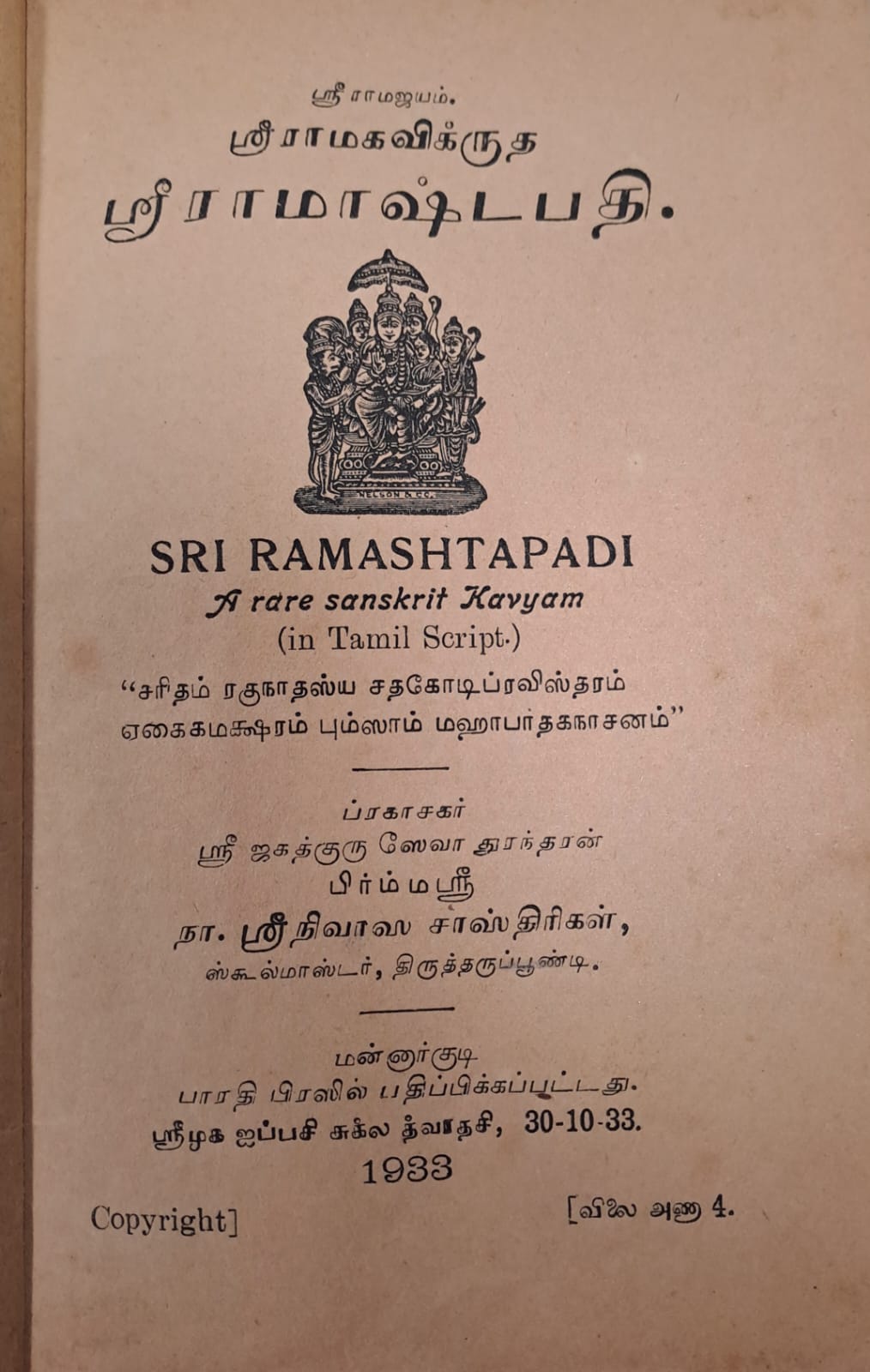
SRI RAMASHTAPADI. A rare Sanskrit Kavyam (in Tamil Script). By Sri Ramakavi.
Published by Brahmasri N. Srinivasa Sastrigal. In 1933. Pages 30. 4 Annas.
In the Preface to this book, Na. Srinivasa Sastrigal writes that Sri Ramakavi has encapsulated the gist of the 24,000 verses of Valmiki’s Ramayana in 24 ashtapadis written in simple Sanskrit language, which can be easily set to tune and sung with musical accompaniments. He adds that he has come forward to print this Sanskrit composition in Tamil script on the advice of the pontiff of the Kanchi Kamakoti Peetham, so that it will have a wider reach.
‘Rama Ashtapadi‘ (Gita Raghavam) was composed by Sri Ramakavi who belonged to the Hosani sect of Karnataka and wrote this at the behest of the ruler of Srirangapattinam. He settled in an agraharam presently known as Tiruvisanallur in Tamil Nadu. Ramabhakti was an important feature of the residents of the village which was home to many great scholars and devotees like Sridhara Venkatesa Ayyaval and Ramabhadra Dikshitar. Ramakavi is said to be the great-grandson of Govinda Dikshitar and therefore, composing music came naturally to him. He combined with it his devotional fervour by adopting the genre of ashtapadi.
It follows the same literary pattern as Jayadeva’s Gita Govindam, having 24 ashtapadis, each having eight charanas, set to the same raga and tala. The ashtapadi itself is in the form of a conversation or description relating to a specific theme, while the slokas prior to and following the ashtapadi carry the story forward. However, unlike the Gita Govindam, Sivagitimala (Kamakshi-Ekamreswara Ashtapadi, popularly called Siva Ashtapadi) and Gita Sundaram (Meenakshi-Sundareswara Ashtapadi), Ramakavi’s ashtapadi on Rama does not have sringara rasa as the predominant sentiment. The entire story of the Ramayana sprinkled with various rasas, unfolds in Ramashtapadi. It is also different from the Sri Rama Ashtapadis written by Upanishad Brahmendra Yati, which abounds with Advaita philosophy.
In Ramashtapadi, Ramakavi reveals his lyrical skill through the songs that take us through the important events in Lord Rama’s life, in chronological order as is found in Valmiki’s Ramayana. The first ashtapadi is a brief summary of the Ramayana, highlighting the purpose of Sri Rama’s avatara, namely, establishment of dharma. The second is in praise of Rama, describing his kalyana gunas and dwelling on his compassion. In the next ashtapadi, sage Viswamitra narrates to Rama the prowess of demoness Tataka, who is finally killed.
The fourth ashtapadi is interesting with a sprinkling of sringara. It describes the enchantment and reaction of the women in Mithila upon Rama’s entry. In the next, Viswamitra tells king Janaka about the two ascetic princes. The sixth ashtapadi describes Janaka sending emissaries to Ayodhya, followed by the marriage festivities of Rama-Sita.
The seventh ashtapadi describes many incidents like how Rama destroys the pride of Parasurama, King Dasaratha deciding to make Rama the yuvaraja leading to Rama’s banishment to the forest and the course of events till Rama tries to dissuade Sita from accompanying him to the forest. In the next ashtapadi Dasaratha wails about his son and Sita to Sumanthra.
The ninth and tenth ashtapadis highlight Sita’s beautiful prayer to river Ganga, the arrival of Rama in Panchavati, as also how Rama lovingly takes Sita around the forest where they all dwell for sometime. In the eleventh ashtapadi, Rama is filled with sorrow upon the loss of his wife; as Jatayu describes the abduction of Sita in the next. The 13th ashtapadi narrates the moving tale of Sabari as Rama comes to her ashram. The signing of the treaty between Rama and Sugriva, and the killing of Vali are described in the 14th ashtapadi, while Tara consoles Lakshmana about the foolish behaviour of Sugriva in the next.
The three ashtapadis — 16 to 18, describe Hanuman’s exploits in Lanka — how he meets Sita, confronts Ravana, burns Lanka and returns. In the 18th, Hanuman reports to Rama about finding Sita. Thereupon the pangs of love suffered by Rama are described in the next verse.
Ashtapadis 20 and 21 go on to describe Vibheeshana’s surrender to Rama, and Samudraraja requesting Rama to pardon his arrogance. The 22nd ashtapadi describes the ensuing battle and the killing of Ravana followed by Sita being reunited with Rama in Lanka. The next verses describe Rama returning with his retinue to Ayodhya wherein he narrates all that happened. The 24th ashtapadi describes Lord Rama’s Pattabhishekam, concluding with the Rishi stotram.
Sriramashtapadi, is an inspired work of poet Sri Ramakavi invoking devotion towards Lord Rama. As suggested by scholars, the ashtapadis can be included in bhajan singing of Sita Rama Kalyanam and Sita Rama Pattabhishekam. Ramakavi’s Sriramashtapadi can be a welcome addition to the repertoire of dancers and musicians working on thematic presentations on Rama.
The slim book which looks its age, must be handled with care, but will be of interest to those on the lookout for less known compositions.
S. JANAKI


