
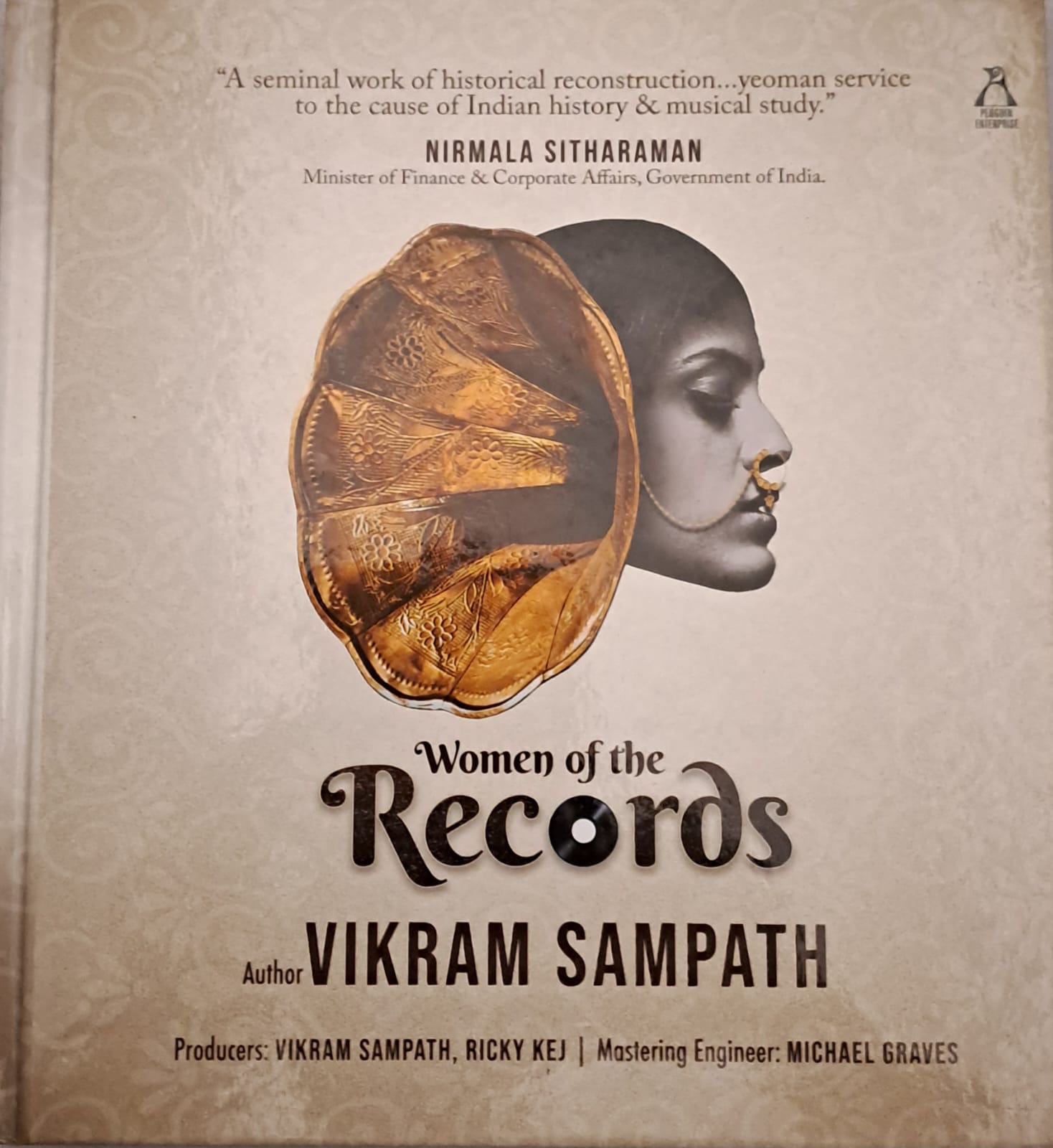
WOMEN OF THE RECORDS. By Vikram Sampath.
Published by Penguin Random House India. In 2021. In English. Hardbound. Pages 133. Comes with a CD. Rs 999.
Across India, women, mostly from the courtesan community, were the pioneers of recording technology in the early 20th century. Yet, their stories have been lost in the sands of time. This book revisits their lives and features, the indefatigable saga of 25 inspiring Indian women musicians from 1902 to 1947. You can even hear their original voices that have been restored and reconstructed in an accompanying CD from shellac discs dating back to 1902 — in 78 rpm records from the Archive of Indian Music (AIM).
This work by author-historian Vikram Sampath, alongwith the producers — music composer Rickey Kej and sound engineer Michael Graves, is a tribute and an effort to recreate the stories, the lives, the magic and the music of these stellar pioneers, but for whose contributions the Indian music industry would not be what it is today.
“Women of the Records” is a richly illustrated coffee table book which brings into focus the exceptional women whose stories provide insight not just into the challenges and struggles they faced in society, but the evolution of Indian classical music.
Some of the women written about include Gauhar Jaan. Malka Jaan of Agra, Salem Godavari, Bangalore Nagarathnamma, Dhanakoti Ammal of Kanchipuram, Bai Sundarabai of Pune, Acchan Bai of Bombay, Noti Binodini of Calcutta, Kali Jaan of Delhi and several others.
The easy to carry, hardbound book is structured thus: commencing with The Journey, followed by three ‘sections’ titled The Pioneers, The Next Wave, and The Rise of the Phoenix. The insightful portion which comes after In Conclusion, comprises Line Notes for the Album Tracks in the CD, a Glossary, and the Bibliography.
The author describes his relentless search for the story of Gauhar Jaan — the Indian subcontinent’s first musician to record commercially on the gramophone, way back in 1902. It is interesting to note that between the first three recording expeditions of The Gramophone Company in India, in 1902, 1904-05 and 1906-07, the women’s recordings of Indian classical music accounted for 80.95 per cent, 83.51 per cent, and 85.36 per cent of the total recorded catalogue of Indian classical music!
Section 2 throws light on the famous women artists who were feted by The Gramophone Company in the second decade of the 20th century — like Coimbatore Thayi, Veena Dhanammal and her daughters, and KB Sundarambal from the south, Janki Bai of Allahabad, Zohra Bai of Agra, Indu Bala and Angur Bala from Bengal.
Section 3 gives details about the Anti-Nautch campaign, and how it badly impacted the lives of such artists, who in turn rose from the ashes as a phoenix. It also narrates the story of iconic women like MS Subbulakshmi, ML Vasanthakumari, Siddheshwari Devi, Begum Akhtar, and Kesar Bai.
It is interesting to note that the recordings by the musicians were colour coded according to the artists’ popularity.
“Women of the Records” is a classy book about several women pioneers who reinvented and transformed an immersive musical pursuit to meet the challenges of a three-minute recording time!
Read it at a go in the Music Academy library. As a bonus you can also listen to the vintage songs in the CD which comes along with the book (as CD drives too have become a thing of the past !)
S. JANAKI


